The Last Human Hand
Or: I almost filed an extension. Instead, I watched the future arrive.

April 15th. Taxes due. Investment sales, multi-state returns, 48 receipts I’d been moving to the back burner since January.
I was this close to hitting “file extension.”
Instead, on a whim, I typed:
“Can you drive?”
Not metaphorically. I mean I actually asked Claude — out loud, in a chat window — if it could navigate a tax filing website on my behalf. Fill in the forms. Click through the screens. Work the thing while I watched.
Remembering a couple weeks ago it couldn’t do this. This time the answer was yes.
Channeling every ounce of giddy excitement, recognizing a moment had arrived, I texted the cousins chat:
“I think this might be the last year a human hand touches a tax return.”
I’m still not sure I was wrong.
What Claude Cowork actually is — for the uninitiated
Claude is an AI — think ChatGPT, same idea — and Claude Cowork is the version that doesn’t just answer questions. It takes action. Not the browser window. The local agent. You can give it access to folders, documents, spreadsheets — and now, critically, it can work inside your browser. Navigate websites, at least one at a time as far as I’ve tried. Read, click, fill out forms, interact with pages. All while you’re watching. All while you’re still the one making every consequential decision.
That last part matters. More on that in a second.
A month ago I couldn't get Claude Cowork to even work on my machine. Over the last few weeks something had been shifting — today, for the first time, the desktop app and the Chrome extension worked as a team. One hand in my local files, one hand on the website.
Jaw drop. A little drool.
Drive, don’t decide
When Claude built what was my first “Skill” — a reusable instruction document she can read at the start of any session, teaching herself exactly how to navigate the e-filing website and complete a federal tax return — she distilled the operating principle into one phrase:
Drive, don’t decide.
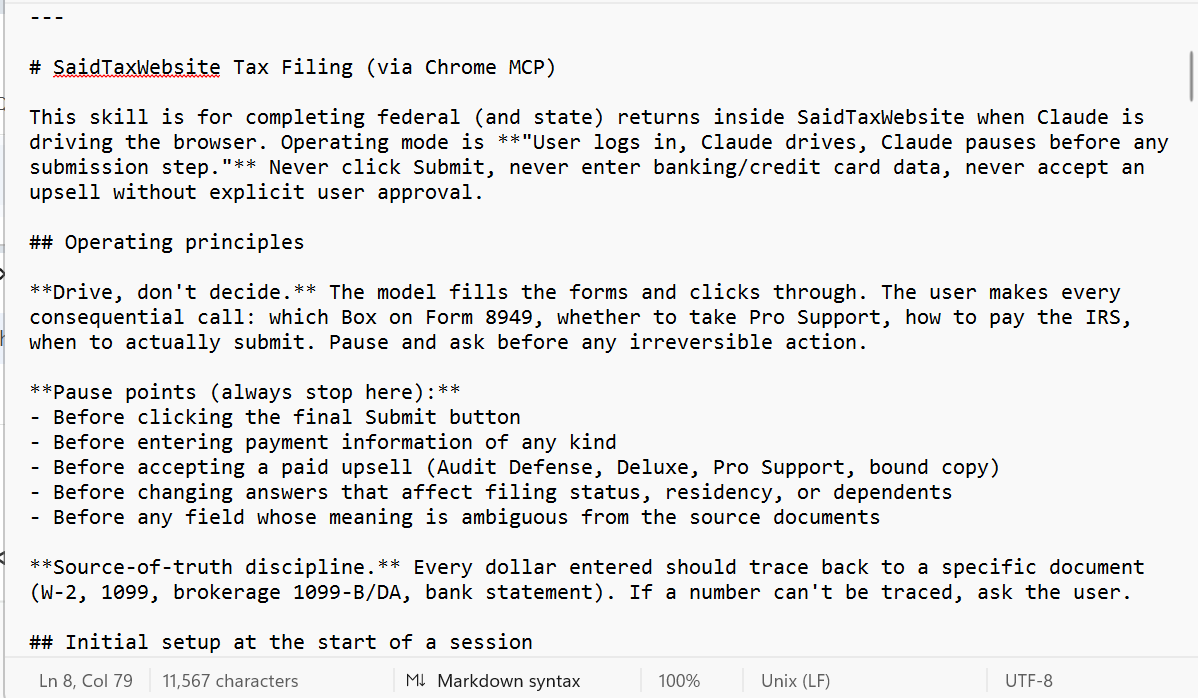
This is the Skill — a document Claude wrote to teach itself how to do this again next time.
The model fills the forms. It clicks through the screens. It works methodically — long pauses, something processing behind the scenes, a couple times me leaning in and asking “How’s it going back there?” But every consequential call — which box on Form 8949, whether to take the standard deduction, how to handle the 1095-A we almost skipped — those belong to the human. Claude stops. Asks. Waits.
This is not passive watching. It requires attention, judgment, and domain knowledge. What changed is where those resources go.
You’re not steering. You’re navigating. Passenger seat, picking the next song, keeping an eye on the map.
I Do, We Do, Clau-Do
Here’s how the day actually broke down. In coaching we call it “I Do, We Do, You Do” — the progression toward autonomy. This day had its own version.
I Do — Warm-up lap
First I did a family member’s taxes on the tax site, a site I’ve used for a couple of years — not even realizing I would be handing over the wheel soon.
We Do — The receipts
I had 48 receipts — four per month — that needed some to be split between an asset category and an expense category. I’d been avoiding this since January. I handed Claude the folder. She pulled out the 8 receipts that required splits. Did the math. Flagged a double payment I had missed. Found a bonus I hadn’t added yet.
I still had to diagnose the double payment, trace how my mishandling had rippled into the asset account, and figure out the proper fix. The detail work took minutes. The judgment work needed me.
What could have slid into another week of avoidance got done. And I stayed at the supervisory level while she scoured the fine print.
Clau-Do — The tax return itself
Complicated transaction-level reporting for each stock trade. Multi-state returns. A client situation I was managing simultaneously — while she was working, I jumped on a call to track down a missing 1095-A form my client needed to avoid an IRS rejection. Double duty. Claude kept working.
I was doing the human phase. Claude was doing everything else.
Beyond — The Skill itself
This one surprised me. When the return was filed, I asked Claude to write a Skill document — a reusable set of instructions for doing this same process on the next return. Instructions written by AI for the next AI.
Something I had just learned about and was trying for the first time. That document now lives in a folder. Ready for next year. Or next week.
What I still did
Full transparency: I still did a 15-hour day.
AI did not hand me my afternoons back. Not yet. What it did was make completion possible — because without the receipt analysis, I would have kicked my books to next week and missed the deadline on my own return. The detailed work I’d been avoiding got done. The return got filed.
I still ran my 8-point checklist. Still reviewed every line. Still did the smell check — the gut check that tells you when a number doesn’t feel right before you can articulate why. That’s not going away.
You still need to know what anomalies look like. You still need the cheat code. But here’s the thing: you can now give Claude the cheat code. Write it down. “When you see a payment to this vendor categorized as an expense AND there’s an open bill — cross-check payables. It’s probably a double entry.” Give it the rules and it deploys them deeply, thoroughly, and precisely. Every time.
The judgment is still yours. The pattern-matching at scale? That’s Claude’s.
One policy we don’t bend on: no AI-generated content goes to a client without human review. That’s not paranoia — AI makes mistakes, sometimes with absolute confidence. Your eyes are the last line of defense. Always.
I wonder if it can do this
That question — I wonder if it can do this? — is the job now.
Not the data entry. Not the filling out forms. Not the cross-referencing. Those are getting handed off, one on-a-whim experiment at a time.
What I keep is the appetite. The knowing what to look for. The understanding of why a number doesn’t feel right. Twenty years of that isn’t replaceable by a model that doesn’t know your client’s habits, your chart of accounts, or the Tuesday conversation that changed the scope.
It’s a little like riding a bike with no hands — you go little by little until you find your balance. You don’t let go all at once. You notice what feels steady and build from there.
But “I wonder if Claude can do this?” — asked with ferocious curiosity, and then actually trying — that’s what keeps you ahead of the curve instead of behind it.
I tried it on a whim. I didn’t know if it would work. Oh, it worked.
Next year is going to be very different
This year: Claude drove for the first time. Built the first Skill. I watched her navigate a tax website in real time. Filed my own return on time — because the detail work I’d been avoiding finally had a driver.
Next year: the Skill exists. The process is documented. The receipts don’t require dread. My prediction — ambitious, hopeful maybe — is that next year Claude is handling the texting back-and-forth with clients to track down missing forms while I supervise the conversation and handle something else entirely.
We are living in exponential times. The jump from this year to next year is not going to feel incremental. It’s going to feel structural.
The jobs that required human hands are becoming jobs that require human eyes. That’s not a smaller job. It’s a different one.
———
My cousin group chat has been quiet since that text.
“I think this might be the last year a human hand touches a tax return.”
Maybe they’re thinking about it. Maybe they’re skeptical. Maybe they’re already asking Claude to drive.
The last human hand — or the first one that didn't need us to make it.
The hands are stepping back. The eyes are still everything.
Evolution is still on offer.
Ready to try it? You don’t need a plan. Just ask: “Can you drive?” See what happens.
The roboteddybears with gizmos and drones at the feet of the great pyramids pretty much says it all
It's that exactly